
When the first summer tells you what the drawings didn’t

Updated: Feb 21
Most homes in India are not uncomfortable all the time.
They are uncomfortable at specific hours.
A bedroom that heats up after 3 pm.
A living room that needs curtains closed through the day.
A balcony that cannot be used for most of the year.
A top floor that feels different from the rest of the house every summer.
Nothing seems “wrong.”
The construction is sound, the finishes are intact.
Yet daily life begins adjusting around the building.
When the Climate Moves In
In Indian climate, a house rarely experiences a single microclimatic condition, during a year.
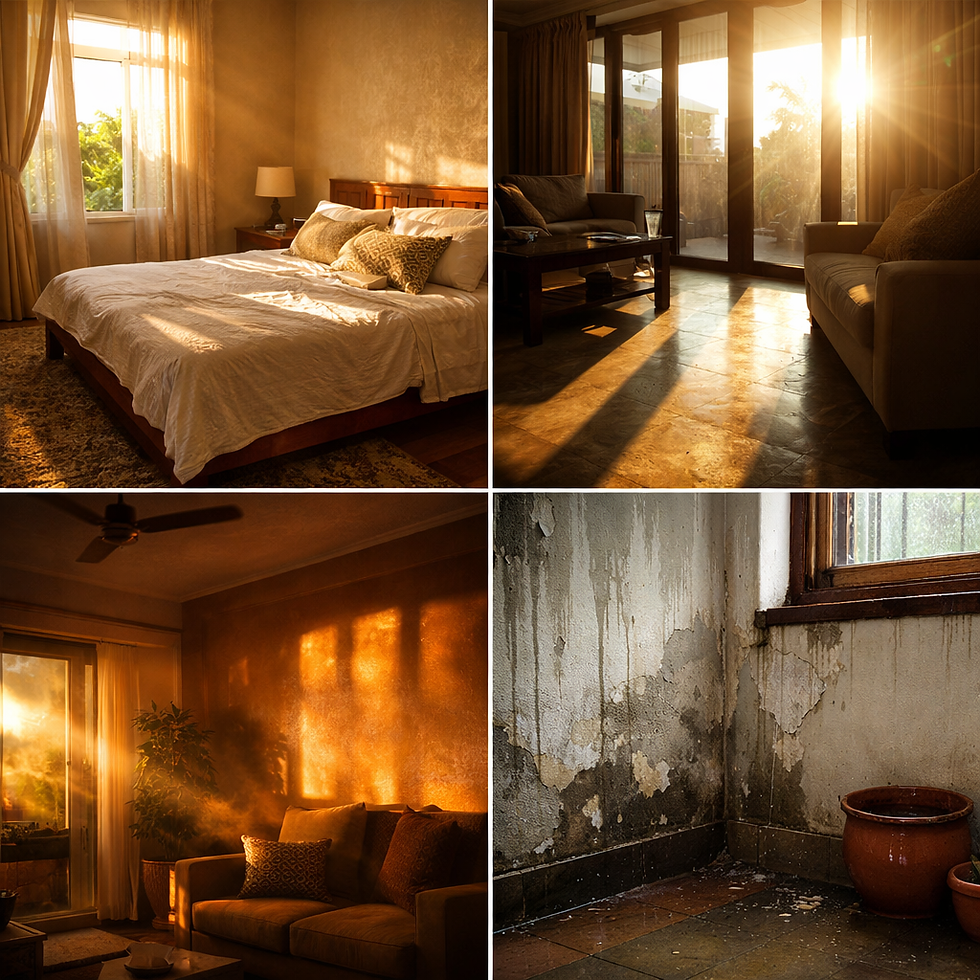
Morning light is welcome.
Afternoon light becomes glare.
Evening heat lingers longer than expected.
Monsoon moisture finds its own path indoors.
So families adapt:
Certain chairs migrate seasonally.
Some rooms become storage by accident.
Fans and cooling run longer in particular corners.
A verandah exists, but is rarely used.
The house functions — but selectively.
Not Failures, Just Assumptions
Most of these outcomes are not construction mistakes.
They come from decisions that seemed reasonable at the time:
The west window added for symmetry.
The darker stone chosen because it looked richer indoors.
The roof finished flat because it simplified structure.
The opening placed where the plan allowed it.
None of these are dramatic choices.
But the Indian climate is not neutral — it tests every one of the construction and design decisions. The building doesn't perform exactly as decided.
Living Without Negotiation

Some homes require constant negotiation with the day — closing, opening, avoiding, compensating.
Others settle into routine more easily.
Windows stay open longer.
Spaces remain usable across seasons.
Materials age gradually instead of abruptly.
The difference is rarely visible in photographs.
It appears in how little the household has to manage the building.
Designing Before the Weather Arrives

Often, the true evaluation of a home happens after the first summer and first monsoon.
Only then do we learn:
Which wall stores heat longer than expected.
Which threshold needed deeper protection.
Which material responds differently outdoors than in a sample.
By then, the design is complete.
Adjustments begin instead.
Fewer Corrections, Not More Additions
There is another way to approach a house.
Before finalising design and materials, the site needs to be observed over the time:
Where the late sun falls.
Which direction the breeze actually comes from, not just the map.
How surfaces behave when exposed to both heat and moisture.
Small shifts follow — a deeper edge, a different proportion, a protected transition.
Even later adaptations then require fewer changes, no dramatic adjustments.
The Long Life of Decisions
In a country, like India, where seasons are pronounced and daily temperature swings are significant, the house is always in conversation with its surroundings.
Every decision becomes part of that conversation.
When assumptions are made early, adjustments continue for years.
When conditions are understood early, the house asks less of its occupants.
At SARV, sustainability is approached in this sense — not as a layer added to a finished design, but as a way of deciding the design itself.
It becomes a method of choosing positions, proportions, materials and transitions with fewer unknowns rather than adding corrective measures later.
Reducing ongoing adjustment is not an extra feature.
It is simply a different way of beginning.
Join the Movement
Are you interested in integrating sustainable design strategies into your projects? Explore the possibilities with SARV: Sustainable.
We’re a Gandhinagar-based architecture studio designing climate-responsive homes and workplaces across diverse Indian climates — thoughtfully tailored to each site, lifestyle, and budget.


Comments